THE RECTORY
St. Stephen’s Episcopal Church was founded in 1725 as a mission church under the name First Society in Ridgefield−Church of England. The name “St. Stephen’s Episcopal Church” was not adopted until 1831. Members met in their homes until 1740 when the church’s first building was erected on Main Street. St. Stephen’s has essentially been in the same location ever since.
The British badly damaged that first building by fire on April 28, 1777, the morning after the Battle of Ridgefield. In 1784 the parish decided to tear it down, but it was not until 1791 that the new one was completed. It was followed by a larger church in 1841, and in 1915 the present stone church, St. Stephen’s fourth, was built. The Rev. William B, Lusk, rector from 1915-1950—the longest rectorate in the church’s history—presided at the first service in the new church on May 2, 1915.
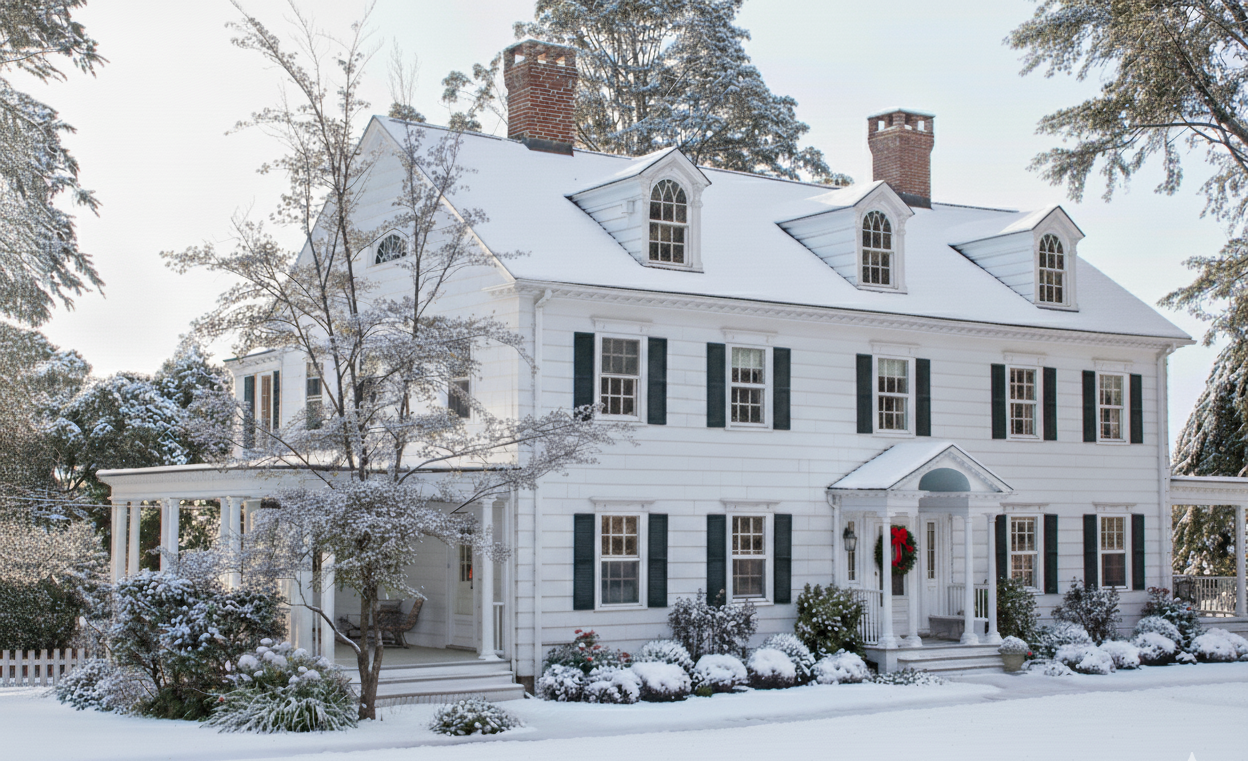
A rectory is the clergy member’s home, and just as St. Stephen’s has had four churches, it has had four rectories. The first was built in 1838 across from the present Ridgefield Public Library. In 1850 the church acquired its second rectory two doors from church property. Upon the death of prominent parishioner Keeler Dauchy, the church in 1887 bought his home, which adjoined church property, for a third rectory. By 1915 the need for a new one—the fourth—was again clear. To make way, the Dauchy home was moved in 1914 to 23 Catoonah Street, where it still stands.
Rev. Lusk and his family were the first to occupy the current rectory, which was completed in 1916. It is a wooden colonial building, but if the vestry had had its way, it would have been constructed of stone. Mr. and Mrs. F. E. Lewis, who had offered a generous donation to construct a new rectory (Mrs. Lewis was on the building committee), preferred a wooden colonial style. When told the vestry wanted it built from stone to match the church, they reneged on their offer. The vestry quickly changed its communal mind.
A three-story, 6,248-square-foot home, the rectory was designed to suit the Lusk family’s lifestyle, which included entertaining many prominent friends. Not to mention it was in keeping with Main Street’s majestic homes. The 2,374-square-foot main floor has a spacious center hall, parlor, living room, office, dining room, kitchen with butler’s pantry, laundry room and an unusual step-down half bath. It features two French and six Dutch doors, four working fireplaces, a covered deck on the south and west sides, and a north porch.
During the rectorate of the Rev. John R. Gilchrist (1990-2003), his wife, Gail, a noted watercolorist and muralist, added artistic elements that are invaluable to the home’s beauty. The walls in the center hall and along the stairs to the second floor appear to be covered in lovely wallpaper. Look more closely. It is the patient work of Gail Gilchrist. Dining room walls boast her murals and the inscription “I am the bread of life,” from John 6:35. Of note and as a sign of a bygone era, the third floor, which has not been used for a very long time, has four small bedrooms “for the help”.
St. Stephen’s Episcopal Church has deep gratitude for its 300-year history. The gratitude extends to the parish’s ability to provide a comfortable home for its clergy, without regard to the vagaries of the real estate market.
The church will also be open for viewing on the day of the Holiday House Tour.